
For many Australians, buying their first home is a milestone that seems to move further away every year. Rising property prices, higher living expenses, interest rates and the challenge of saving a substantial deposit have made homeownership increasingly difficult. Many prospective buyers spend years waiting for the right time, hoping to save more, find a better-priced property or gain greater confidence in the market.
However, what if the first property you buy does not have to be the home you live in?
What if your first property could instead be an investment that helps you build the equity required to purchase your dream home later?
This is an alternative approach worth considering. Rather than waiting until they can afford their preferred home, some buyers are choosing to enter the property market through an investment property. The objective is to acquire an asset with sound investment fundamentals, build equity over time and potentially use the proceeds to strengthen their deposit for a future home purchase.
It is not a guaranteed shortcut to homeownership. However, with the right property, financial structure and investment strategy, it can create opportunities that a traditional savings-only approach may not offer.
Why are so many first-home buyers stuck waiting?
The biggest challenge for aspiring homeowners is often not the inability to service a mortgage. It is accumulating the initial deposit and associated purchase costs.
Several factors contribute to this delay:
- Insufficient deposits: Saving a 20% deposit while managing rent and everyday expenses can take years.
- Rising property prices: The target deposit can increase while buyers are still saving.
- Limited market knowledge: Many buyers are unsure about where to invest, what to look for or how to assess future growth potential.
- Budget constraints: The property they want to live in may be beyond their current borrowing capacity.
- Market uncertainty: Concerns about interest rates, economic conditions and property cycles often lead to indecision.
- Emotional decision-making: Buyers sometimes focus exclusively on finding their ideal home rather than considering what property ownership could achieve financially.
The result is a familiar cycle. People wait for the perfect financial circumstances, but the market does not necessarily wait with them.
The latest Australian Bureau of Statistics lending figures also highlight the changing first-home buyer scenario. In the September quarter of 2026, there were 26,415 new owner-occupier first-home buyer loan commitments, representing an 8.6% decline from the previous quarter. This indicates that purchasing a first home remains a significant financial decision for many Australians.
An alternative strategy: Buy an investment property before your first home
An investment property can potentially serve as a stepping stone towards homeownership. Instead of purchasing a property based on personal preferences, buyers can identify an affordable location with strong fundamentals, rental demand and potential for long-term capital growth.
The strategy involves three broad stages:
- Enter the property market: Purchase an investment property within your financial capacity, even if it is not in the suburb where you eventually want to live.
- Build equity: Allow the property to generate rental income and potentially appreciate in value over time. Additional mortgage repayments may also help build equity.
- Convert equity into a home deposit: Once the financial position allows, consider selling the investment property and using the net proceeds towards the deposit for an owner-occupied home.
The underlying principle is simple. Instead of waiting for property prices to become affordable, buyers use an investment asset to participate in the property market while working towards their long-term homeownership goal.
A real client story- From a $280,000 investment to a $620,000 property valuation
One of our clients decided to take a different approach rather than continue waiting to save enough money to purchase their first home.
In 2023, they purchased their first investment property in North Queensland for $280,000.
The initial financial commitment looked something like this:
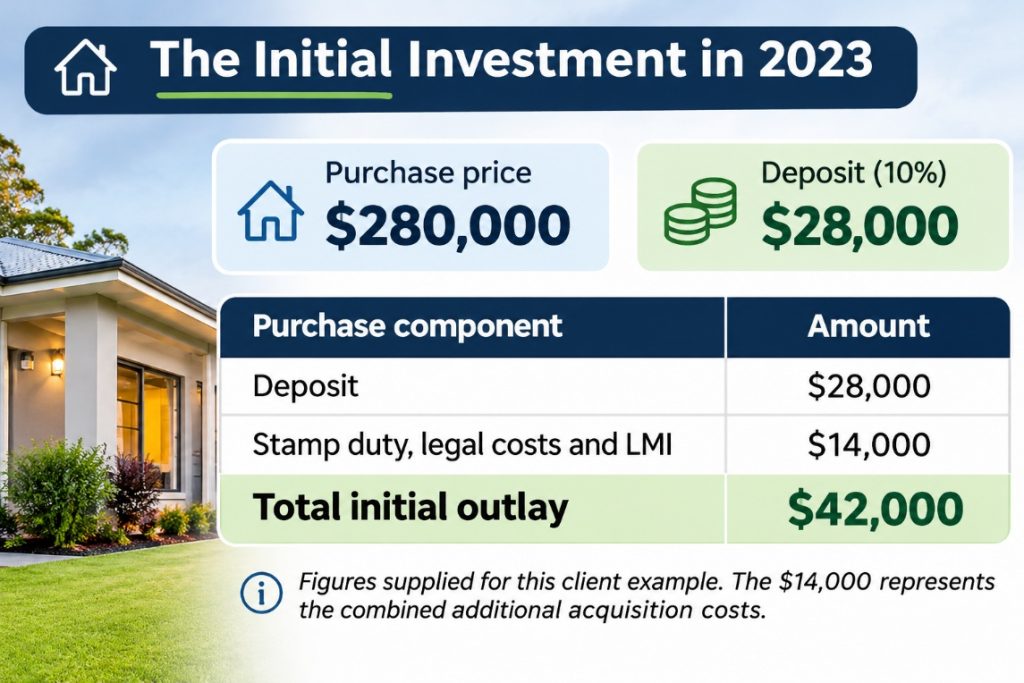
Rather than purchasing a property they could not comfortably afford to live in, they focused on acquiring an investment asset that offered the potential to grow in value.
By March 2026, the property had been valued at $620,000.
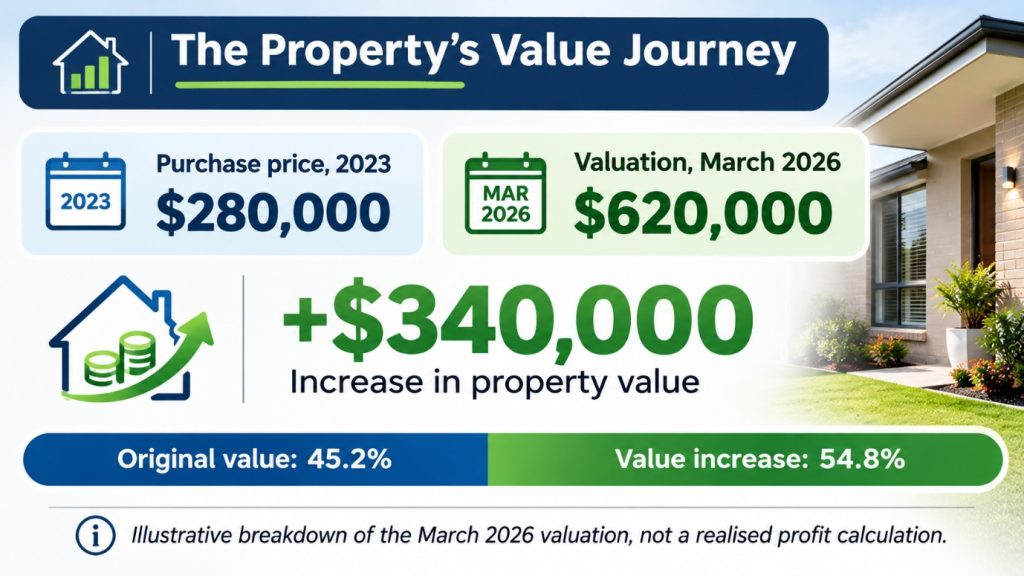
The increase in value was $340,000, representing approximately 121.4% growth over the original purchase price. After selling the property and accounting for applicable taxes and other costs, the clients were able to increase their available deposit and move closer to purchasing their first home in Queensland.
This is what makes the story interesting. Their first property was not necessarily the home they wanted to live in. It was the asset that helped them work towards buying that home. It was a decision to take calculated action rather than remain in a waiting game.
An important distinction: The $340,000 represents the increase in the property’s market value, not the net profit or cash available after selling. The outstanding mortgage, selling expenses, capital gains tax and other adjustments determine the actual amount retained.
Why can this strategy work?
Property investing allows buyers to participate in the market with a deposit rather than funding the entire purchase price themselves.
This is where leverage becomes important.
For example, a buyer who purchases a $280,000 property with a 10% deposit controls an asset worth $280,000 with an initial deposit of $28,000, excluding acquisition costs.
If the property appreciates, the increase applies to the property’s full market value, not just the initial deposit.
However, leverage also magnifies losses when property values decline. Mortgage repayments, interest, maintenance and other holding costs continue regardless of market performance.
There are three important considerations:
1. Capital growth potential
The location should have credible economic and housing fundamentals. Employment opportunities, infrastructure investment, population growth, housing supply and local amenities can influence long-term demand.
2. Rental income
A property with a healthy rental market can help offset mortgage repayments and ownership expenses. Rental demand should be assessed using local vacancy rates, achievable rents and tenant demographics.
3. Financial flexibility
The investment should be affordable to hold even if interest rates rise, the property remains vacant for a period or unexpected maintenance becomes necessary. The objective is to build wealth without creating financial pressure.
How to approach this strategy without taking unnecessary risks
Buying an investment property first requires a different mindset from purchasing a home to live in. The decision should be driven by investment fundamentals rather than emotional preferences.
Here are five steps worth considering.
1. Establish your borrowing capacity
Speak to a mortgage broker before looking at properties. Understand how much you can borrow, how much deposit you can contribute and whether you can comfortably service an investment loan.
Lenders assess investment income, existing liabilities, living expenses and your ability to manage repayments. An investment loan may also have different interest rates and lending requirements from an owner-occupied loan.
2. Look beyond expensive capital cities
First-time investors do not necessarily need to enter markets such as Sydney, Melbourne or Brisbane. Regional Queensland and other emerging markets may offer more accessible entry prices. However, affordability alone is not an investment strategy.
Research local employment, population trends, infrastructure, rental demand and future housing supply. A low purchase price does not automatically make a property a good investment.
3. Understand the actual cost of ownership
A 10% deposit may appear attractive, but buyers must account for additional expenses.
These include:
- Transfer duty and conveyancing costs.
- Loan establishment fees and Lenders Mortgage Insurance (LMI), where applicable.
- Building and pest inspections.
- Property management fees.
- Landlord insurance and council rates.
- Maintenance and unexpected repairs.
- Interest repayments and potential cash-flow shortfalls.
A realistic financial assessment should consider the entire holding period, not simply the initial deposit.
4. Have an exit strategy before you buy
The ultimate objective is to purchase a home to live in. Therefore, investors should establish an approximate timeframe for selling, the equity they hope to accumulate and the price range of the home they eventually want to purchase.
It is equally important to assess whether selling is the best option. Depending on borrowing capacity and available equity, retaining the investment property and purchasing another property may sometimes be possible. However, this requires careful assessment of debt levels and cash flow.
5. Account for taxes and government incentives
This is particularly important for buyers planning to purchase their first home in Queensland.
The Australian Taxation Office generally allows eligible Australian resident individuals to apply a 50% capital gains tax discount when an asset has been owned for at least 12 months. However, the taxable capital gain must be calculated using the applicable cost-base rules, capital losses and other adjustments.
There is another important consideration. Purchasing an investment property can affect eligibility for first-home buyer benefits.
Queensland’s first-home transfer duty concession generally requires buyers to have never held an interest in a residence anywhere in Australia or overseas. Therefore, owning an investment property may disqualify someone from this concession, even if they have never lived in that property.
Interestingly, Queensland’s First Home Owner Grant has different eligibility rules. Someone who has owned a property solely for investment purposes since 1 July 2000 may still qualify for the grant on a subsequent new home, subject to the applicable conditions and evidence requirements.
Buyers should therefore obtain professional tax and legal advice before structuring their investment.
The bigger picture: Investment first, homeownership next
The strategy can be understood through a simple progression:
Step 1: Build your initial deposit
Savings and available borrowing capacity
Step 2: Purchase an investment property
Choose based on affordability and investment fundamentals
Step 3: Build equity over time
Potential capital growth, rental income and loan reduction
Step 4: Review your financial position
Assess selling costs, tax, remaining debt and borrowing capacity
Step 5: Purchase your own home
Use available net proceeds towards your home deposit
Is buying an investment property first right for everyone?

Not necessarily! Property markets move in cycles, and capital growth is never guaranteed. Some locations experience substantial appreciation, while others remain stagnant or decline. Interest rates, employment conditions, population movements and government policy can all influence property performance.
There is also an opportunity cost to consider. If an investor buys an investment property and subsequently sells it, they may incur transaction costs and lose access to certain first-home buyer concessions.
The Australian Government’s expanded 5% Deposit Scheme, which commenced on 1 October 2025, also gives eligible first-home buyers another pathway to homeownership without having to save a traditional 20% deposit. However, previous property ownership can affect eligibility, so buyers should compare both approaches before committing.
The right strategy depends on individual circumstances, income stability, borrowing capacity, risk tolerance and long-term financial objectives.
Wrapping It Up
The biggest lesson from my client’s experience is that homeownership does not always have to begin with buying the home you intend to live in.
Sometimes, the more practical decision is to purchase an asset that can help you build the financial foundation for that home.
Waiting until everything feels perfect can mean missing opportunities. Equally, rushing into an investment without proper research can create financial difficulties. The objective is not simply to buy a property. It is to make a property decision that moves you closer to your ultimate financial goal.
My client’s journey from a $280,000 investment in 2023 to a $620,000 valuation in March 2026 is a reminder of what taking calculated action can potentially achieve. They did not start by buying their dream home. They started by buying an opportunity. Sometimes, the smartest way to buy your first home is to let your first investment property help you get there.