
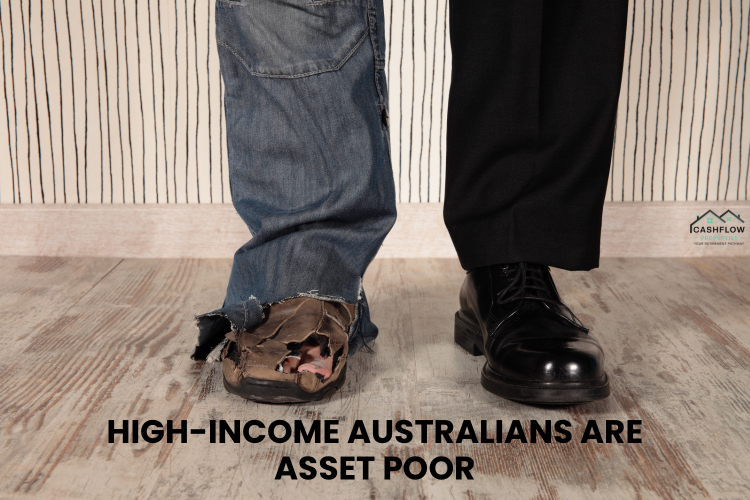
A high salary can make life comfortable. It can pay for a better home, nicer holidays, private schooling, newer cars and more choices. But a high income does not automatically create wealth. This is one of the biggest misunderstandings in personal finance. Someone earning $300,000 or $500,000 a year may look wealthy from the outside, yet have surprisingly little in assets that can generate income or grow in value without requiring them to work for every dollar.
The distinction matters in Australia, where household wealth has become increasingly tied to property, superannuation and financial assets. The Australian Bureau of Statistics reported that total household wealth reached almost $18.85 trillion by December 2025. It increased by $453.7 billion, or 2.5 per cent, during that quarter alone. Much of that increase came from land and dwellings and financial assets.
Income is not Wealth
Income is the money that comes in. Wealth is what remains after liabilities are taken into account and, more importantly, what can continue to hold or increase its value.
For instance, consider two professionals earning $300,000 a year. The first spends most of that income on an expensive home, luxury vehicles, frequent travel, private clubs, restaurants and other lifestyle expenses. The second lives comfortably but directs a meaningful portion of their surplus income towards property, shares, superannuation and other productive assets. Their incomes may be identical. Their financial positions after 10 or 20 years could be completely different.
The ABS notes that wealth is generally distributed less equally than income. In 2022-23, Australia’s Gini coefficient for equivalised disposable household income was 0.307. Wealth tends to be considerably more concentrated because ownership of property and financial assets compounds over time. That is why a large pay packet should be viewed as an opportunity to build wealth, rather than wealth itself.
Lifestyle inflation quietly absorbs rising incomes
One of the biggest obstacles for high earners is lifestyle inflation. A person receives a substantial pay rise and initially feels financially better off. Then the larger house arrives. The older car is replaced with a more expensive model. Holidays become international rather than domestic. Restaurants become a regular expense rather than an occasional treat. None of these choices are necessarily irresponsible. The problem begins when spending rises almost as quickly as income.
A household can therefore earn more every year without significantly increasing its net worth. Australian household spending remains substantial. ABS data showed household spending was 5 per cent higher in December 2025 than a year earlier, despite a 0.4 per cent monthly decline in December. Higher spending on new vehicles was among the areas supporting expenditure during the month.
The issue is not whether Australians should spend money. It is whether every increase in income needs to produce an equivalent increase in consumption.
Taxation Reduces What is Available to Invest
High-income earners also face a more obvious challenge: Taxation.
Australia’s personal income tax system means that a larger salary does not translate dollar-for-dollar into investable cash. High earners can also face additional taxation on certain superannuation contributions.
For example, the ATO’s Division 293 rules apply an additional 15 per cent tax to certain concessional superannuation contributions when an individual’s relevant income and concessional contributions exceed $250,000, subject to the applicable calculation. This makes the difference between earning money and accumulating capital even more important.
The objective is to recognise that after-tax income is a finite resource. Once tax, housing costs and lifestyle expenses are paid, whatever remains needs to be deliberately directed towards assets if wealth is the goal.
The Missing Ingredient: Leverage
Property remains an important part of the Australian wealth story partly because of leverage. A person with $200,000 in savings may be able to buy a modest investment asset outright. Alternatively, that capital could potentially form part of the deposit and acquisition costs for a much larger property, subject to borrowing capacity, lending criteria, interest rates and risk. This is the basic power of leverage. Borrowed capital allows an investor to gain exposure to a larger asset than they could purchase using savings alone.
But leverage works both ways. Property values can fall, interest costs can rise and vacancies can affect cash flow. Borrowing should therefore be approached as a financial tool rather than a shortcut to wealth. The broader Australian household balance sheet illustrates just how significant debt and assets are together. At December 2025, Australian households had around $8.78 trillion in financial assets and approximately $3.40 trillion in liabilities. Long-term loans accounted for about $3.19 trillion of those liabilities.
It is vital to understand the difference between borrowing to acquire an asset with potential long-term value and borrowing to fund consumption.
Turning Income into Income-Producing Assets
Gradually moving from relying entirely on employment income towards owning assets that can produce income or appreciate over time should be the goal to achieve success.
This could include investing in and managing:
- Investment property
- Shares and diversified funds
- Superannuation
- Commercial property
- A business
- Other productive investments suited to the investor’s circumstances
The ABS data provides an interesting picture of Australian household financial assets. At December 2025, households held about $4.12 trillion in pension fund assets, $1.93 trillion in deposits and $1.70 trillion in shares and equity.
The important point is that wealth does not have to come from one asset class. A high-income household could use part of its income to maintain a comfortable lifestyle, while directing another portion towards assets that can potentially produce rent, dividends, interest, business income or capital growth. Over time, the objective is for those assets to become increasingly important to the household’s financial position.
Luxury is Not Necessarily Wealth-Building

There is nothing inherently wrong with buying luxury goods. The problem is confusing luxury consumption with financial success. A $150,000 vehicle may provide comfort, performance and status, but it does not normally produce an income for its owner. In most cases, it also loses value over time. The same applies to expensive watches, designer goods, high-end electronics and other discretionary purchases.
These purchases can be perfectly reasonable when they are made from genuine surplus income. They become financially problematic when they consume the capital that could otherwise have been invested.
A wealthy lifestyle and a wealthy balance sheet are not the same thing. In fact, people who are quietly accumulating assets may appear considerably less affluent than people who spend heavily on visible possessions.
Depreciating Assets Can Create the Illusion of Wealth
Cars are one of the clearest examples. Someone may drive a $120,000 vehicle and live in an impressive home. To neighbours, colleagues or social media followers, that person may appear financially successful.
But if the car is financed, loses value and requires substantial ongoing costs for insurance, maintenance and registration, it may be contributing very little to net wealth. The same principle applies to many consumer purchases. An asset should not be judged simply by its price. A more useful question is:
What is this purchase likely to be worth to me financially in five or ten years?
A property may generate rent and potentially appreciate. Shares may generate dividends and potentially appreciate. Superannuation can compound over decades.
A luxury vehicle generally does neither.
That distinction becomes increasingly important as income rises because high earners have more money available to direct into either productive assets or consumption.
The Real Opportunity for High-Income Australians
The advantage of earning a high income is not simply being able to spend more. It is having more capacity to accumulate assets.
The first step is to control lifestyle inflation. The second is to understand how much income remains after tax and essential expenses. The third is to consistently direct a portion of that surplus towards assets capable of producing income or long-term growth. This does not mean living an unnecessarily frugal life. It means allowing lifestyle improvements to happen more slowly than income growth.
If income rises by $30,000, the entire amount does not need to disappear into a bigger mortgage, a more expensive car or additional holidays. Some of it can become an investment. That is how a salary can gradually become a portfolio.
The Difference Becomes Obvious Over Time
Someone who earns a high income for 20 years but spends almost everything can reach the end of that period with a lifestyle to show for it but limited financial independence.
Another person earning the same amount, paying the same taxes and enjoying a comfortable lifestyle could finish the same period with substantial property, superannuation and investment holdings. The difference is not necessarily income. It is what happened to the income after it arrived.
Australia’s household wealth data reinforces the importance of owning assets. Household wealth increased by $224.9 billion, or 1.2 per cent, in the March quarter of 2026, with residential land and dwelling values increasing by $302 billion during the quarter. Household borrowing also increased by 1.3 per cent.
Property is not guaranteed to rise, and leverage carries risk. But the broader lesson remains relevant: changes in asset values can have a much larger impact on net worth than changes in salary alone.
From High Income to Real Wealth
Being a high-income earner is a strong starting position. It is not the destination. The real financial transition happens when earned income begins buying assets instead of simply buying a more expensive lifestyle. That means keeping luxury spending within sensible limits, recognising which purchases depreciate, understanding the impact of tax, using debt carefully and steadily building ownership of productive assets.
The objective is not to stop enjoying the money earned through hard work. It is to make sure that some of that money continues working long after the pay cheque has been spent. A high income can create a comfortable life. A well-built asset base can create financial resilience and, eventually, greater financial freedom. The difference lies in what happens to the money in between.