
An Australian property perspective on inflation, wages, construction costs, scarcity and the long-term cost of waiting
Inflation is usually described as the enemy of wealth. It reduces purchasing power, increases household expenses, pushes up construction and operating costs, and can make borrowing more expensive. Yet for investors who own the right appreciating assets, inflation can tell a very different story.
The important question is not simply whether prices are rising. It is what you own while those prices are rising.
For Australian property investors, this distinction has become increasingly relevant. The latest Australian Bureau of Statistics data shows that the Consumer Price Index rose 3.8% in the year to June 2026, while the Housing group rose 6.8%. New dwelling prices increased 5.8% and rents increased 3.6%. Meanwhile, wages rose 3.3% over the year to the March quarter of 2026.
Understanding the Relationship Between Inflation and Appreciating Assets
Inflation means that the purchasing power of money declines as the general price level rises. If a property, piece of land or other productive asset becomes more expensive to acquire or reproduce, its nominal value can rise alongside the broader economy.
Property has a particularly interesting relationship with inflation because it is made up of several components that are themselves affected by inflation. There is the land, which is inherently limited in supply. There are construction materials, labour, energy, transport, finance, planning and infrastructure. There is also rental income generated by the property.
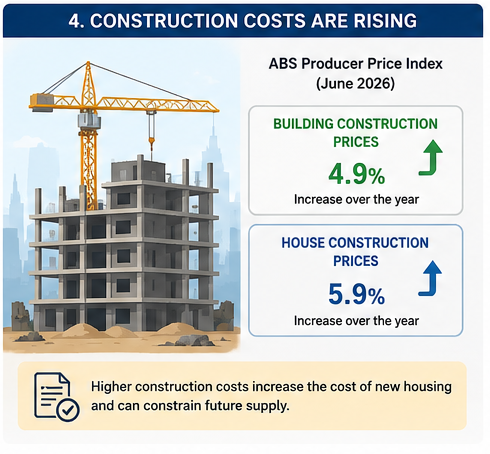
When the cost of these inputs increases, the replacement cost of housing can rise. This can create a chain reaction: inflation raises input costs, higher input costs raise construction and replacement costs, and constrained supply can then place upward pressure on rents and existing property values.
The Salary Problem Investors Often Underestimate
One of the biggest mistakes prospective investors make is assuming that their salary will eventually catch up with the price of the asset they want to buy.
The latest data shows why this assumption can be dangerous. Australia’s Wage Price Index increased 3.3% annually to the March quarter of 2026. In comparison, annual CPI inflation was 3.8% in June, while the Housing group increased by 6.8%.
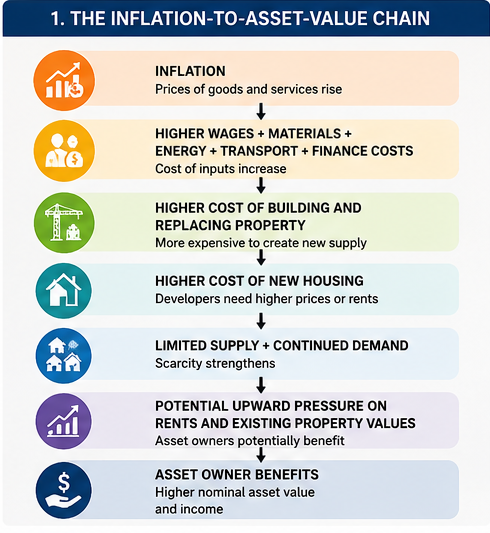
Consider a simplified example. A professional earning $100,000 receives a 3.3% salary increase, taking income to $103,300. Now imagine they are considering a $700,000 property and comparable property prices rise by 6%, taking the property to $742,000. The salary has increased by $3,300 while the property has increased by $42,000. The difference is $38,700.
This is not a forecast of property prices. It is an illustration of the affordability challenge that occurs when asset prices rise faster than incomes. Your salary does not necessarily need to decline for an asset to become less affordable. It only needs to grow more slowly than the asset.
Construction Inflation Can Push Up the Cost of New Housing
There is another inflationary mechanism property investors should understand: replacement cost.
The ABS reported that new dwelling prices increased 5.8% in the year to June 2026, with project home builders raising base prices to pass through higher labour and materials costs.
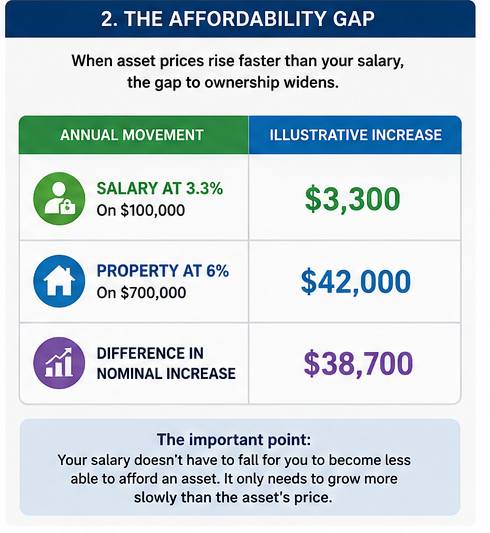
The ABS Producer Price Index provides an additional perspective. Building construction output prices rose 4.9% over the year to June 2026, while house construction prices rose 5.9%. The June quarter alone saw house construction prices increase 2.0%, the largest quarterly rise since September 2022. The ABS specifically noted that labour shortages continued to pressure builders, particularly for bricklayers, carpenters and concreters.
If it becomes substantially more expensive to construct a new dwelling, developers need higher selling prices or rents for projects to remain viable. When development becomes more expensive, some projects may be delayed, redesigned or become financially unviable. That can affect the pace at which new supply reaches the market.
Skilled Trades Are Part of the Inflation Story
Construction inflation is not simply about timber, concrete, steel and other materials. It is also about the people required to build and maintain Australia’s housing stock.
Jobs and Skills Australia continues to track shortages across the Australian labour market, with technicians and trades remaining a major area of shortage. The ABS also identified ongoing skilled labour shortages as a source of price pressure in residential construction.
If demand for electricians, plumbers, carpenters, bricklayers and other skilled workers remains high while supply is constrained, labour costs can rise and projects can take longer. That can mean higher construction costs, longer completion times, higher financing costs during delays and more expensive renovations.
These costs do not exist in isolation. They feed into the economics of housing supply.
Scarcity Is What Can Make Inflation More Relevant to Property
Inflation becomes particularly interesting when it meets scarcity. Australia does not simply need more houses. It needs housing in places where people want to live, work and access services.
The National Housing Supply and Affordability Council’s 2026 State of the Housing System report said that around 980,000 new homes could be expected to be delivered during the Housing Accord period under its revised forecast, and that the 1.2 million target was projected to be reached in September 2030, beyond the Accord period. The Council also highlighted the importance of housing being supplied in the right locations.
This matters because housing markets are fundamentally local. A new house built far from a major employment centre does not necessarily solve a shortage of housing close to that employment centre. Well-located land is inherently scarce.
Add population growth, household formation, planning constraints, infrastructure requirements, construction costs and labour shortages, and the ability to increase supply quickly becomes more difficult.
.
The Price-Rise Effect Can Be Seen Throughout the Property Economy
Inflation does not necessarily arrive as one large price increase. It can move through the property ecosystem in stages.
A builder may face higher labour costs. A supplier may charge more for materials. A developer may face higher financing and infrastructure costs. A landlord may face higher insurance, maintenance and compliance expenses. A new home may therefore cost more to construct, while a tenant may face higher rent if rental supply remains constrained.
The June 2026 ABS data makes this particularly clear. Housing inflation of 6.8% was significantly above overall CPI inflation of 3.8%. Within housing, new dwellings increased 5.8% and rents increased 3.6%. An aspiring property owner can therefore experience a very different inflation rate when measuring the cost of entering the housing market than the headline CPI suggests.
The Investor’s Choice Is Not Simply Cash Versus Property
None of this means investors should abandon cash. Cash and liquid investments have an important role in emergency funds, deposits, liquidity management and portfolio diversification.
The question is what happens when an investor holds only cash for a prolonged period while the assets they ultimately want to own continue to become more expensive.
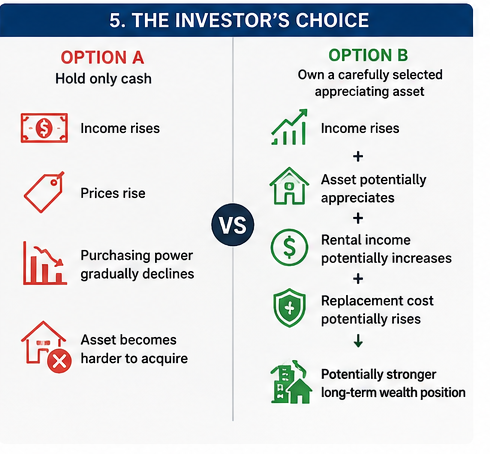
A cash-only investor may see income increase while prices rise, gradually reducing the purchasing power of savings. An investor who owns a carefully selected appreciating asset may potentially benefit from capital appreciation, rental income, rising replacement costs and land scarcity. None of these outcomes is guaranteed, and debt, interest rates, taxation, vacancies and maintenance remain important.
Australia’s Property Market Also Demonstrates Why Selection Matters
A sophisticated inflation argument should not suggest that all Australian property is rising uniformly. The current market is highly uneven.
Cotality’s July 2026 Housing Chart Pack reported that Sydney dwelling values fell 1.2% in June and were 3.7% below their January 2026 peak, while Perth values were 23.9% higher over the previous year. Melbourne values declined 1.0% in June and were 0.9% lower over the year. This divergence is a reminder that ‘Australian property’ is not one market.
Inflation can create favourable conditions for appreciating assets, but investors still need to identify markets and properties with strong underlying fundamentals. Population growth, employment, infrastructure, land scarcity, rental demand, supply pipelines, affordability and economic diversity all matter.
Inflation Can Be a Transfer Mechanism
Perhaps the most useful way to understand inflation is to think of it as a mechanism that changes the relative value of different forms of wealth.
Someone holding $500,000 in cash still has $500,000 nominally. But if the cost of the asset they want to purchase rises significantly, that $500,000 buys a smaller proportion of the asset.
An investor who owns a scarce, productive asset may experience the opposite effect. The nominal value of the asset may rise as the economy reprices land, labour, construction and services.
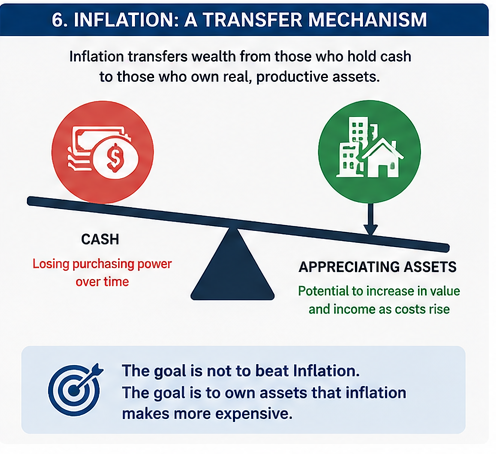
This is why the question should not simply be, ‘How much money do I have?’ It should also be, ‘What will that money be able to buy in five, ten or twenty years?’ That is a much more useful long-term wealth question.
The Real Cost of Waiting
For prospective investors, the biggest risk may not always be buying at the wrong time. Sometimes it is waiting indefinitely for the perfect time.
Nobody knows exactly where property prices, interest rates, inflation or wages will be five years from now. But investors can understand structural forces.
If wages rise at 3.3% while housing-related costs rise faster, waiting does not automatically make property more affordable. If construction costs rise, replacement becomes more expensive. If skilled trades remain constrained, new supply can take longer and cost more to deliver. If well-located land remains scarce, supply cannot respond infinitely.
The combination of these forces can create a widening gap between what people earn and what desirable assets cost.
Inflation Is Not an Investment Strategy
There is one critical distinction investors should never overlook: inflation does not make a bad asset good.
A poorly located property can underperform despite inflation. A property in an oversupplied market can struggle. An investor who over-borrows can be hurt by interest rates. Maintenance, insurance, taxes, vacancy and transaction costs can materially affect returns. A property can also rise in nominal terms while producing disappointing real returns after inflation and expenses.
Therefore, the objective should not be to buy property simply because inflation exists. The objective should be to identify high-quality, scarce and productive assets that have characteristics that may allow them to preserve and grow wealth over long periods.
The Bottom Line
Australia’s latest data provides an important lesson for investors. CPI inflation was 3.8% in the year to June 2026. Housing inflation was 6.8%, new dwelling prices rose 5.8%, and rents increased 3.6%. Meanwhile, wages were growing at 3.3% annually in the March quarter. Building construction prices rose 4.9% over the year to June, while house construction prices rose 5.9%.
These figures do not prove that property prices must rise. They do, however, demonstrate why investors need to think beyond today’s price tag.
Your salary is measured in dollars. Your wealth is ultimately measured by what those dollars can buy.
That is why inflation can potentially become a friend to investors who own scarce, productive and appreciating assets. The goal is not to hope for inflation. The goal is to understand where inflation is pushing prices, identify assets that have the potential to benefit from those forces, and build a portfolio capable of preserving purchasing power while creating long-term wealth.
In an inflationary economy, the smartest question may not be ‘How do I avoid rising prices?’ but ‘What should I own while prices are rising?’