
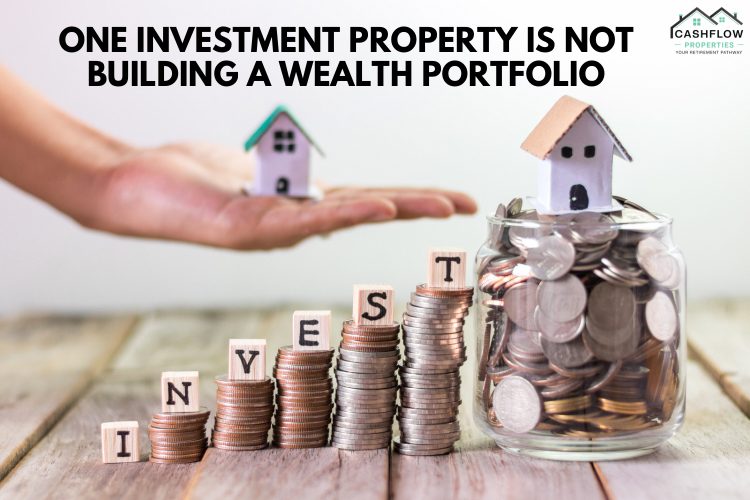
For many Australians, buying an investment property is seen as the first major step toward financial security. It is often marketed as the smart path to wealth creation, tax savings, and long-term financial growth. Yet there is a significant difference between owning an investment property and building a true property portfolio.
One is usually centred around owning an additional asset.
The other is designed to create financial independence.
Unfortunately, many investors only realise this difference after they have already exhausted their borrowing capacity, taken on too much debt, or found themselves financially trapped with one negatively geared property that does little to improve their lifestyle.
The Reality Behind Owning One Investment Property
Across Australia, investment property ownership continues to grow. According to recent housing finance data, investors account for a substantial share of new residential lending activity, particularly as Australians continue searching for ways to build wealth outside traditional savings. However, despite the growing number of investors, very few actually build portfolios capable of replacing their active income.
This is because most people approach property investing with the mindset of buying a single property rather than creating a long-term portfolio strategy.
Typically, the structure looks familiar. An investor purchases one property, takes on a large mortgage, claims negative gearing benefits, and hopes capital growth will eventually deliver wealth. On paper, it appears sensible. In reality, many investors remain heavily dependent on their salary to support both their home loan and investment debt.
Owning one investment property with one mortgage rarely creates meaningful passive income. Instead, it often creates additional financial pressure disguised as wealth creation.
The issue becomes even more obvious when life circumstances unexpectedly change.
The Financial Vulnerability Most Investors Ignore
Many Australian households are carrying two significant debts at the same time. One is their owner-occupier mortgage, and the other is their investment property loan. While this may seem manageable during stable employment and steady market conditions, the structure can become fragile very quickly.
If a job is lost, if illness or permanent disability impacts income, or if a major family emergency occurs, the entire strategy can suddenly unravel. In many cases, one negatively geared property does not provide financial security. Instead, it increases reliance on active income at the exact moment that income becomes uncertain.
This is one of the biggest misunderstandings in modern property investing. Owning property alone does not automatically create financial freedom. In fact, without proper structure, it can simply increase financial exposure.
The Negative Gearing Mindset
For years, negative gearing has driven investment activity across Australia. Many buyers enter the market focused heavily on tax deductions and short-term financial benefits. While negative gearing can certainly reduce taxable income, too many investors mistake tax savings for wealth creation.
There is a major difference between reducing tax and building sustainable income.
In many situations, investors purchase expensive properties in high-demand suburbs simply because they expect strong capital growth or attractive tax deductions. The downside is that these purchases often consume a large portion of borrowing capacity almost immediately.
By the time investors realise that one property alone will not replace their income or create long-term flexibility, lending restrictions, rising interest rates, and debt servicing limitations have already reduced their ability to scale further.
This is why so many Australians stop at one or two investment properties. Not because they lack ambition, but because they lack a scalable strategy.
Building a Property Portfolio Requires a Completely Different Approach
Building a property portfolio is not about emotion, prestige, or owning a “dream investment.” It is about designing a system that eventually replaces active income with passive income. That requires a completely different mindset.
Professional portfolio builders focus on planning, speed, scalability, and execution. They understand that property investing is not just about buying assets. It is about building a structure capable of surviving market cycles, interest rate changes, and economic uncertainty.
Emotion plays very little role in these decisions. Successful investors do not buy properties simply because they like the suburb or could imagine living there themselves. Instead, they focus on numbers, rental demand, yield, infrastructure growth, affordability, and long-term portfolio sustainability. This strategic mindset is often what separates portfolio builders from everyday property buyers.
Why Most Investors Never Move Beyond Two or Three Properties
One of the biggest barriers to portfolio growth in Australia is borrowing capacity. Many investors purchase one or two high-value properties and quickly discover they can no longer secure additional lending.
As interest rates rise and living expenses increase, serviceability calculations become tighter. Banks assess existing debts more aggressively, making it harder for investors to continue expanding.
Without a structured acquisition strategy, investors can become stuck very early in the journey.
This is particularly common when buyers focus entirely on negatively geared metropolitan properties with low rental yields and high debt levels. While these assets may perform well over the long term, they often reduce the investor’s ability to continue acquiring more income-producing properties.
As a result, many portfolios stall before they ever become financially meaningful.
The Acquire – Consolidate – Enjoy Strategy
At Cashflow Properties, the investment philosophy is built around a much simpler but highly strategic framework:
Acquire → Consolidate → Enjoy.
Rather than focusing on purchasing one expensive “perfect” property, the strategy centres around building scale first.
The first phase is acquisition. This involves purchasing as many affordable, high-performing properties as possible while borrowing capacity and affordability still allow. The focus is on markets that offer strong rental demand, accessible entry points, and long-term growth potential.
This phase requires decisive action and disciplined execution. Investors who wait too long or become emotionally attached to individual properties often lose valuable opportunities as lending conditions tighten over time.
The second phase is consolidation. Once the portfolio reaches a targeted size, attention shifts toward reducing debt, improving cash flow, restructuring finance, and strengthening overall portfolio resilience. This stage is critical because it transforms a heavily leveraged portfolio into one capable of generating sustainable income.
The final phase is enjoyment. At this point, debt pressure has reduced significantly, passive income improves, and the investor gains greater lifestyle flexibility. The portfolio begins working for the investor rather than the investor constantly working to support the portfolio.
That is the ultimate objective of strategic portfolio building.
Real Investors Are Already Applying This Model
Cashflow Properties has helped more than 20 investors acquire over 10 properties within a three-year period using this acquisition and consolidation approach. The key difference was not luck or timing. It was strategy.
These investors approached property investing as a long-term business model rather than an emotional purchase.
The same philosophy was used by Bharat Patel, who successfully built a portfolio of more than 60 properties while continuing to remain active in the market. His approach demonstrates that scalable wealth creation through property is not about chasing status or speculation. It is about understanding finance, timing, structure, and disciplined execution.
Property Investing Without Strategy Can Become Expensive
One of the biggest mistakes Australians make is entering property investing without a clear roadmap. Many purchase properties based on media headlines, fear of missing out, tax benefits, or emotional attachment to certain locations.
But building a successful portfolio requires much more than enthusiasm.
It requires understanding borrowing structures, serviceability, debt management, cash flow planning, risk mitigation, and long-term exit strategies. Without this foundation, investors can easily become asset-rich on paper while remaining financially stressed in everyday life.
The real goal should never be to simply own an investment property. The goal should be to build a portfolio capable of creating options, resilience, and eventually financial independence.
2 Responses
Very well articulated
Thanks Kalpesh